

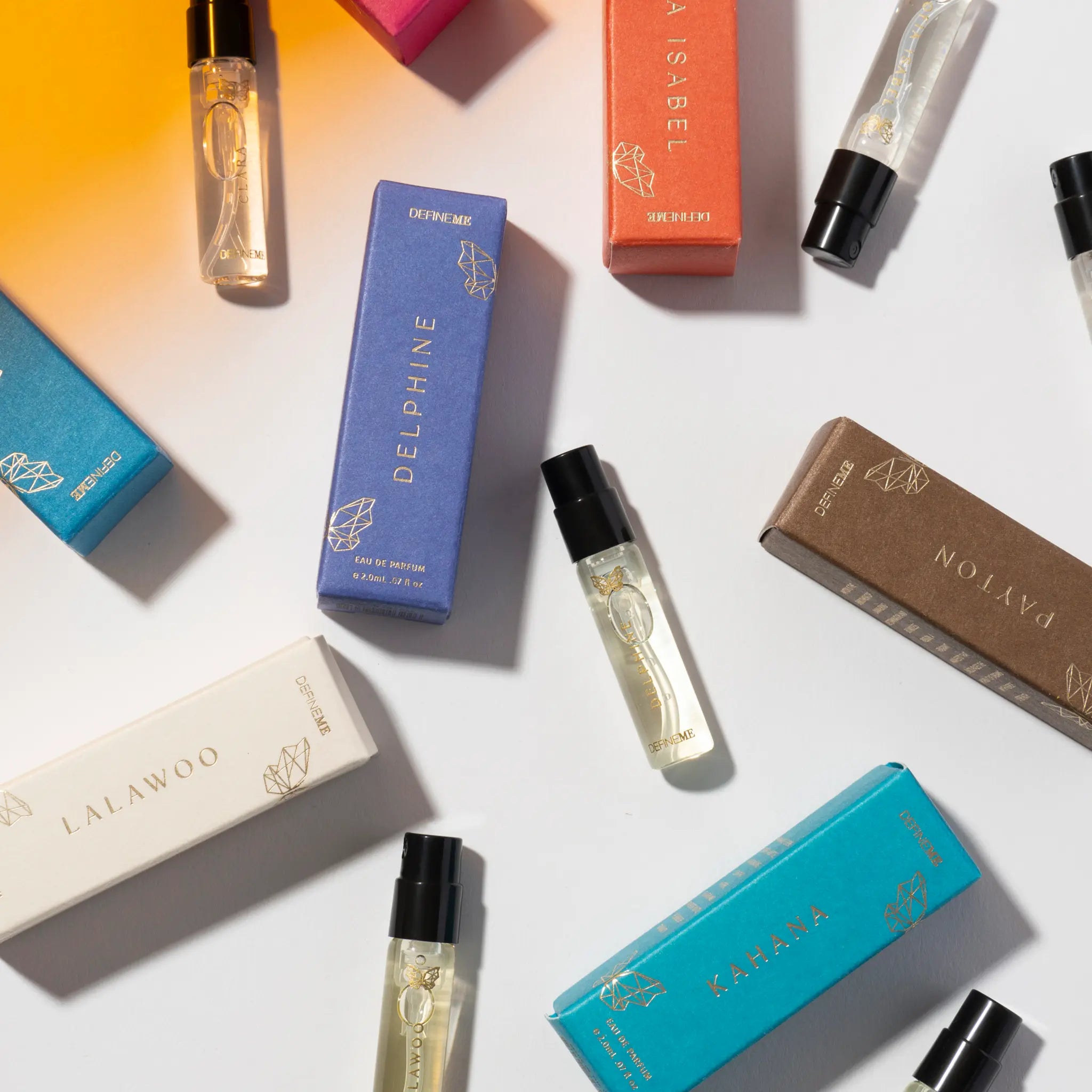

You spray a perfume in the store, fall in love with it on the spot, and buy it without a second thought. Then you get home, spritz it on your wrist, and... it's not quite the same scent you fell for an hour ago. Sound familiar?
Here's the truth: you're not imagining it, and your skin didn't "betray" you. Perfume is designed to change. It's not a static scent that smells identical from the second it leaves the nozzle to hours later — it's more like a story with a beginning, middle, and end. Understanding how that story unfolds is the difference between picking a fragrance you like in the moment and finding your signature scent.
It Starts With the Fragrance Pyramid
Every well-built perfume — including every DefineMe scent — is structured around three layers, often called the fragrance pyramid: top notes, middle (or heart) notes, and base notes. Each layer is made of different molecules, and those molecules evaporate at different speeds. That's really the whole secret.
Top notes are light, volatile, and quick to evaporate. Think citrus, light fruits, or airy florals. They're what you smell first — in the bottle, on the paper strip in the store, in that first spritz — and they're also the first to disappear, sometimes within 15 minutes.
Middle notes, or heart notes, are the soul of the fragrance. They emerge as the top notes fade and tend to be richer: florals, spices, gourmand accords. This is usually where a perfume "settles" into what most people would call its true personality, and it can last a few hours.
Base notes are the heavyweights — woods, musks, amber, vanilla, resins. They evaporate the slowest, which is why they're what lingers on your scarf the next day. They're also what give a fragrance its staying power and depth.
When you smell a perfume in the bottle or on a paper strip, you're mostly getting a concentrated hit of the top notes, with the middle and base barely present. That's one bottle experience. It's real, but it's incomplete.
Why Skin Changes Everything
Paper doesn't have a pH, a temperature, or an oil production schedule. You do. And that's exactly why the same fragrance can smell noticeably different from person to person, or even from your left wrist to your right.
A few things are happening the moment perfume meets skin:
- Body heat activates the molecules. Warmth speeds up evaporation, which is why fragrance tends to project more from pulse points like your wrists, neck, and behind your ears — these run warmer and help "diffuse" the scent.
- Skin chemistry blends with the formula. Your skin's natural oils, pH balance, and even your diet or hormones subtly interact with a fragrance's molecules, which is why a scent that's all vanilla and warmth on a friend might read more citrus and clean on you.
- The layers unfold in real time. On skin, you actually get to experience the full pyramid — top notes fading into the heart, heart notes settling into the base — instead of the concentrated snapshot you get from a bottle or a strip.
This is exactly why we always encourage trying a fragrance on skin rather than judging it purely from the bottle. A scent that feels "too sweet" or "too strong" in that first spray is often just showing you its loudest, most volatile top notes — give it 20-30 minutes, and you'll meet the version that's actually going to live with you.
And Then There's the Air
The third experience — how a fragrance smells once it's diffused into the air around you — is its own thing entirely, shaped by sillage (how far and how strongly a scent projects) and how the fragrance interacts with your environment.
Humidity, temperature, and even the fabric of your clothes all affect how a scent moves through a room. Warmer, more humid air tends to amplify projection and make a fragrance feel bigger and closer, while cooler, drier air keeps it closer to the skin. A fragrance you wore on a summer night out might feel entirely more intimate the next time you spray it in a cold, dry office.
This is also why the way a scent lingers on clothing, hair, or a scarf can smell different from how it reads directly on your skin — you're smelling a blend of the base notes and whatever fabric or fibers absorbed the fragrance along the way, minus the warmth and skin chemistry that shaped the earlier stages.
So Which "Version" Is the Real One?
All of them. That's the honest answer. A fragrance isn't one static scent — it's a living sequence, and the bottle, the skin, and the air are just three different chapters in the same story. The bottle gives you an introduction. Your skin gives you the full arc. The air gives you the lasting impression you leave behind.
If you're perfume shopping — whether that's testing something new from us or anywhere else — give it time before you decide. Spray it on your skin, not just a strip. Let it sit for half an hour. Come back to it later in the day. The fragrance that unfolds slowly, that surprises you a little as it goes, is usually the one worth keeping around.